Today, I’d like to share how I personally think about system design. I am exploring whether agentic software really makes sense for a small product-based company that wants to enter the online market.
This is part of my current semester module, and here I am mostly thinking in architecture terms.
Comparing two worlds:
- A traditional cloud-native serverless system
- An AI-native agentic system
Both are built on AWS. Both are realistic. But their philosophy is very different.
My Assumptions
I am imagining a small traditional company that:
- Is well established in a local physical market
- Wants to enter online gradually
- Has legacy inventory software running on-premises
- Wants minimal upfront cost
- Expects ~5,000 orders per month initially
- Wants basic analytics for decision making
- Prefers managed services over infrastructure management
I am intentionally choosing cloud-native serverless because I do not want the company to waste time managing servers. I want them to focus on business, not hardware.
Part 1 — The Traditional Cloud-Native System
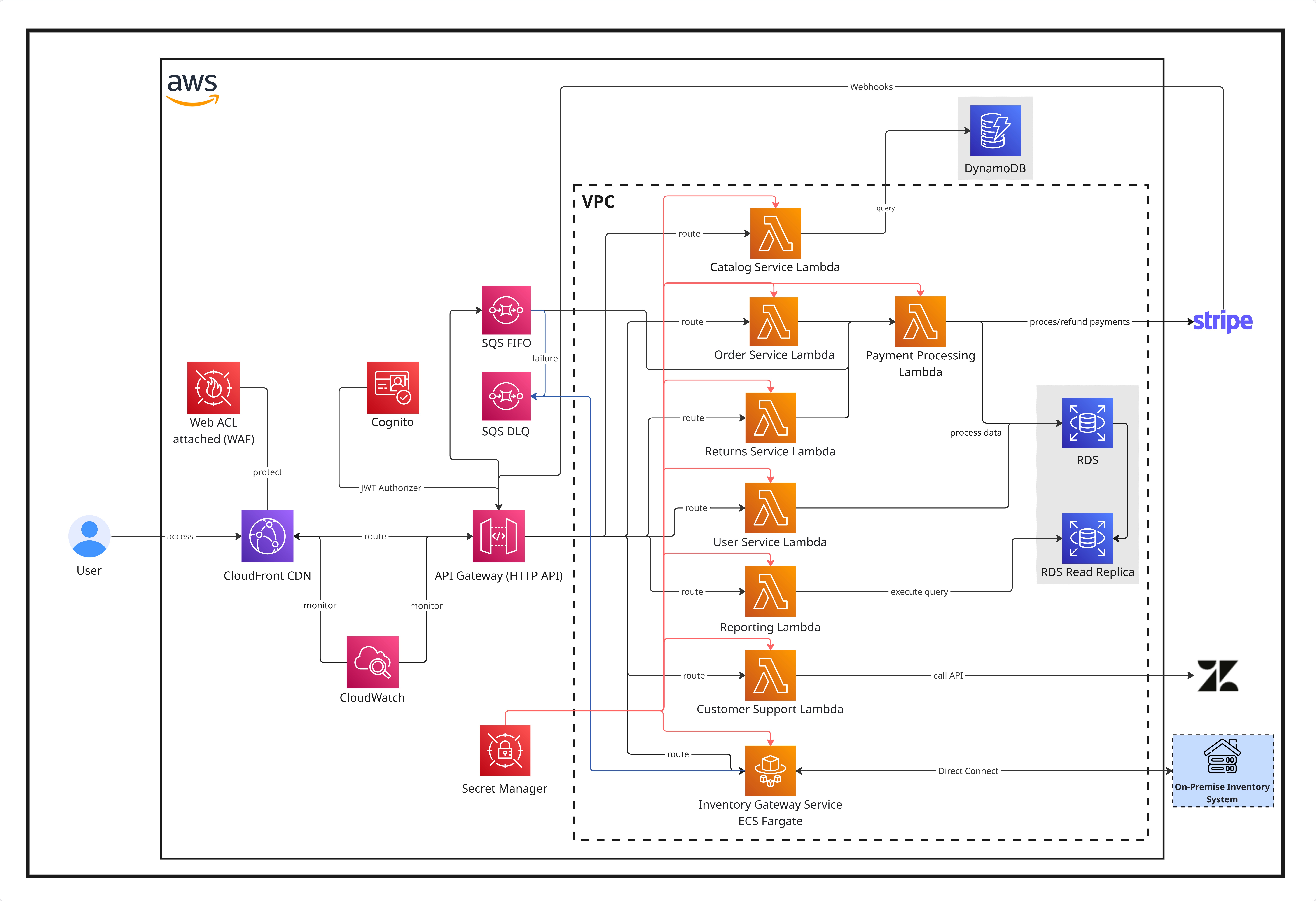
This architecture has a classic serverless e-commerce backend.
Why I Choose Serverless
Serverless is preferable because:
- No EC2 maintenance
- No scaling headaches
- Automatic elasticity
- Global availability
- Pay-per-use pricing
For a small company, this reduces operational complexity dramatically.
How I Imagine the Flow
The user enters the platform through CloudFront CDN, which reduces latency globally. AWS WAF is attached to CloudFront to protect against common web attacks (SQL injection, bots, etc).
Amazon Cognito is used for authentication. I like Cognito because it handles JWT tokens, user pools, login via email/phone, and removes the need to build auth from scratch.
Next, API Gateway (HTTP API) as the central routing layer. I think of it as the managed entry door to all backend services.
Inside a dedicated VPC, multiple AWS Lambda functions run:
- Catalog Service Lambda
- Order Service Lambda
- Payment Processing Lambda
- Returns Service Lambda
- User Service Lambda
- Reporting Lambda
- Customer Support Lambda
I use DynamoDB for catalog data because it scales automatically and works well for product listings.
Amazon RDS (PostgreSQL) for transactional data like orders and users because it provides relational consistency.
For payments, I integrate with Stripe using webhooks. In addition, SQS FIFO to handle asynchronous payment confirmation and retries. If failures exceed retry limits, messages are pushed to SQS DLQ.
Zendesk API from Lambda for customer support.
For legacy inventory, I use an ECS Fargate Inventory Gateway Service that connects via Direct Connect (or secure hybrid connectivity) to the on-prem inventory system.
I store secrets in AWS Secrets Manager and monitor logs and metrics using CloudWatch.
Why This Architecture Works
This architecture is:
- Deterministic
- Predictable
- Operationally safe
- Automatic scaling
The availability is high because:
- CloudFront is globally distributed
- Lambda scales horizontally
- DynamoDB is multi-AZ default
- RDS can be multi-AZ
Security-wise:
- WAF protects edge
- IAM roles enforce least privilege
- Cognito handles authentication
- Secret Manager avoids hardcoded credentials
- VPC isolates compute
which is production-grade and realistic.
Part 2 — The Agentic AI-Native System
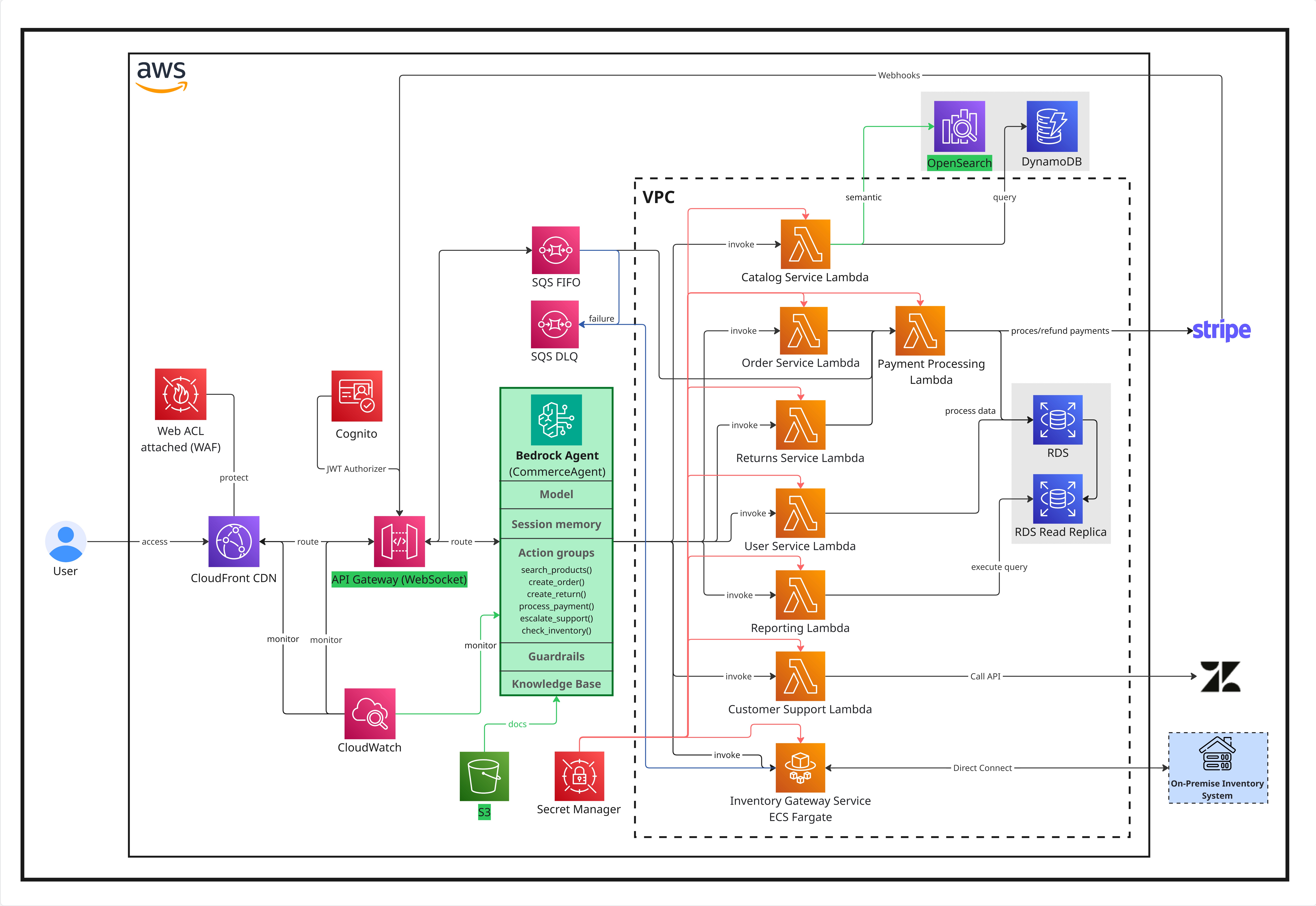
Now I ask myself: what if the entire front-end interaction becomes conversational? Instead of navigating pages, I imagine the user chatting with an AI commerce assistant.
Why I consider Agents
Agents make sense for:
- Natural interaction
- Personalization
- Workflow automation
- Reasoning over structured + unstructured data
But they also introduce cost and complexity :/
How I Imagine the Agentic Flow
Keep CloudFront + WAF + Cognito same. Security fundamentals do not change.
HTTP API is replaced with WebSocket API and AWS Bedrock Agent as the brain.
The agent consists of:
- A selected foundational model
- System instructions (commerce-specialized prompt)
- Guardrails
- Session memory
- Knowledge base
- Action groups (tools)
I let Bedrock manage session memory (internally backed by DynamoDB).
Important part: Action Groups that map to backend tools:
search_products()-> Catalog Lambdacreate_order()-> Order Lambdacreate_return()-> Return Lambdaprocess_payment()-> Payment Lambdacheck_inventory()-> Inventory Lambdaescalate_support()-> Customer Support Lambda
Now the key difference:
The agent decides which Lambda to invoke.
Semantic Search Upgrade
In the traditional system, catalog search is keyword-based.
In the agentic version, Amazon OpenSearch (vector search) enables semantic search.
Imagine:
- User says “I want something comfortable for winter hiking under €100.”
- The agent converts it to embedding.
- OpenSearch returns semantically relevant products.
- If nothing matches, fallback to DynamoDB.
This is a major UX improvement.
Knowledge Base & FAQs
Let’s assume that the company documents and FAQs are uploaded into S3, which feeds the Bedrock Knowledge Base.
Now the agent can:
- answer return policy questions.
- explain shipping timelines.
- escalate to Zendesk if needed.
This reduces human support load.
What Stays the Same
I kept:
- RDS for transactions
- SQS for async processing
- Stripe integration
- ECS Fargate for legacy inventory
What is the difference then? Rather than replacing backend logic, the orchestration is changed, which is important.
Cost Estimation
Assumptions (/month):
- 10,000 active users
- 5,000 orders
- 100,000 API calls
- Average 2-3 LLM calls per user session (agentic system)
- Moderate data storage
| System | Estimated Total (/month) |
|---|---|
| Traditional | €175 – €245 |
| Agentic | €400 – €750 |
The additional cost for agentic system is heavily coming from Bedrock followed by OpenSearch (small cluster).
Security Reflection:
Security remains strong in both cases. However, I must additionally worry about agentic system regarding:
- Prompt injection
- Data leakage via LLM
- Guardrail misconfiguration
- Model hallucination
So governance becomes more important.
Feature Comparison
Traditional System:
- Deterministic
- Stable
- Easy to audit
- Lower cost
- Clear data flow
Agentic System:
- Conversational UX
- Personalized experience
- Semantic search
- Automated workflows
- Higher cost
- Higher uncertainty
Verdict
I think traditional cloud-native systems are about control and agentic systems are about adaptability.
I believe small companies should first build a stable deterministic backbone. I would not replace the core transactional system with an LLM, but an agent can be layered on top once the system is stable.
Agentic software makes sense when:
- Customer interaction complexity increases
- Support costs become high
- Personalization becomes competitive advantage
I don’t think every small company immediately needs an agent, but I do think the market is changing.
Overall, this is how I see it:
Cloud-native is about abstracting servers, and AI-native is about abstracting workflows.